Usage
Command Format by Installation Method
Examples use the PyPI command. For a downloaded script, run commands from the directory containing github_monitor.py and keep the same arguments:
| Installation | Command |
|---|---|
| PyPI or pipx | github_monitor [OPTIONS] |
| Manual script on macOS or Linux | python3 github_monitor.py [OPTIONS] |
| Manual script on Windows | python github_monitor.py [OPTIONS] |
For example, github_monitor --setup becomes python3 github_monitor.py --setup on macOS or Linux. Use python on Windows. Replace placeholders such as <github_target> with a GitHub username or complete profile URL.
Activate the tool's virtual environment before running these commands. For a downloaded script, run them from the directory containing github_monitor.py.
For first-time configuration, follow Setup & First Run. Use Doctor Preflight to check a setup before monitoring.
Monitoring Mode
To monitor specific user activities and profile changes, simply enter the GitHub username as a command-line argument (github_username in the example below):
It will track all user profile changes (e.g. changed followers, followings, starred repositories, username, email, bio, location, blog URL, number of repositories) and also all GitHub events (e.g. new pushes, PRs, issues, forks, releases etc.).
If you have not saved GITHUB_TOKEN, the -t flag remains available as a one-run fallback. The value may remain in shell history or process listings:
If you generated a configuration file as described in Configuration File, but saved it under a different name or in a different directory, you can specify its location using the --config-file flag:
If you want to monitor changes to a user's public repositories (e.g. new stargazers, watchers, forks, issues, PRs, discussions, changed descriptions etc.) then use the -j flag:
By default, missing issues, pull requests and discussions are reported as closed only after a separate lookup confirms their closed state. Verification uses at most five extra HTTP requests per monitoring cycle across all repositories, with no automatic retries or redirects. Pending items take turns across cycles. Title and author edits do not count as closures or additions.
Items that remain open, cannot be verified or exceed the budget stay in the previous snapshot, preventing false closure and addition alerts when they reappear. Deleted, transferred or inaccessible items are not reported as closed without confirmation, so their counts can remain unchanged. Set VERIFY_REPOSITORY_CLOSURES = False in the configuration file to restore immediate disappearance-based alerts without verification requests.
By default, only user-owned repos are tracked. To include forks and collaborations, set GET_ALL_REPOS to True or use the -a flag:
If you want to monitor only specific repositories instead of all user-owned repositories, you can do it via the --repos command-line flag or the REPOS_TO_MONITOR configuration option (see Repositories to Monitor). Use the --repos flag with a comma-separated list of repository names:
This will only monitor detailed changes (stargazers, watchers, forks, issues, PRs, discussions, etc.) for the specified repositories. The --repos flag requires the -j flag to be enabled and overrides the REPOS_TO_MONITOR configuration option.
Note: When using a specific list, newly created repositories will NOT be automatically monitored - only repositories explicitly listed will be monitored.
If you want to track a user's daily contributions then use the -m flag:
Daily contribution checks read the requested day from a wider 30-day GitHub calendar window that ends at the following midnight. This avoids transient partial counts that narrow or farther-future GraphQL windows can return.
If for any reason you do not want to monitor GitHub events for the user (e.g. new pushes, PRs, issues, forks, releases etc.), then use the -k flag:
The tool runs until interrupted (Ctrl+C). Use tmux or screen for persistence.
You can monitor multiple GitHub users by running multiple instances of the script.
The tool automatically saves its output to a github_monitor_<github_target>.log file. It can be changed in the settings via the GITHUB_LOGFILE configuration option or disabled completely via DISABLE_LOGGING / the -d flag.
Set ASCII_LOG_SEPARATORS to "Auto" (default) to use ASCII separator-only lines on Windows, "On" to use them on every operating system or "Off" to preserve Unicode separators in logs everywhere. Terminal separators stay Unicode. Log files and all other logged text remain UTF-8.
Terminal Output
Use --help for examples grouped by task and matched to your installation.
Monitoring mode prints the settings that are actually in effect before the first check.
Optional features appear once you switch them on.
Use --verbose or --debug for the full startup summary, including output paths, notification settings, push event limits, secret sources and runtime information.
Use --truncate N or TRUNCATE_CHARS to limit screen line width. Set it to 999 to detect the terminal width automatically. Truncation does not change log files and is ignored when logging is disabled with -d.
Use --push-commits-limit N and --push-files-limit N to control how much of a large push is reported in full. See Push Event Commits.
The tool clears the terminal when monitoring starts. Set CLEAR_SCREEN to False to keep whatever is already on the screen.
The screen is never cleared when output is redirected to a file or a pipe, in debug mode or for a command that prints a result and exits, such as --doctor, --help and the test senders.
Two settings add detail to what a run prints. VERBOSE_MODE adds the decisions the run made and DEBUG_MODE adds timestamped technical traces. Both are off by default, both are independent of each other and both have a flag that wins over the file, --verbose and --debug. DELIVERY_CONFIRMATIONS is on by default and controls whether verbose mode confirms each delivered email and webhook alert. See Verbose and Debug Output.
Coloured Terminal Output
GitHub Monitor colours live terminal output and help by default. Saved log files stay plain text.
Turn colour off for one run with --no-color or permanently with COLORED_OUTPUT = False. Colour is also disabled for redirected output, NO_COLOR or an unsupported terminal. See Terminal Colours for details and Windows support.
Override individual colours with COLOR_THEME. It is merged over the built-in theme, so you only name the parts you want to change:
See Terminal Colours for every theme key and the accepted colour and style names.
Listing Mode
There is another mode of the tool that displays various requested information (-r, -g, -f and -l flags).
If you want to display a list of public repositories (with some basic statistics) for the user then use the -r flag:
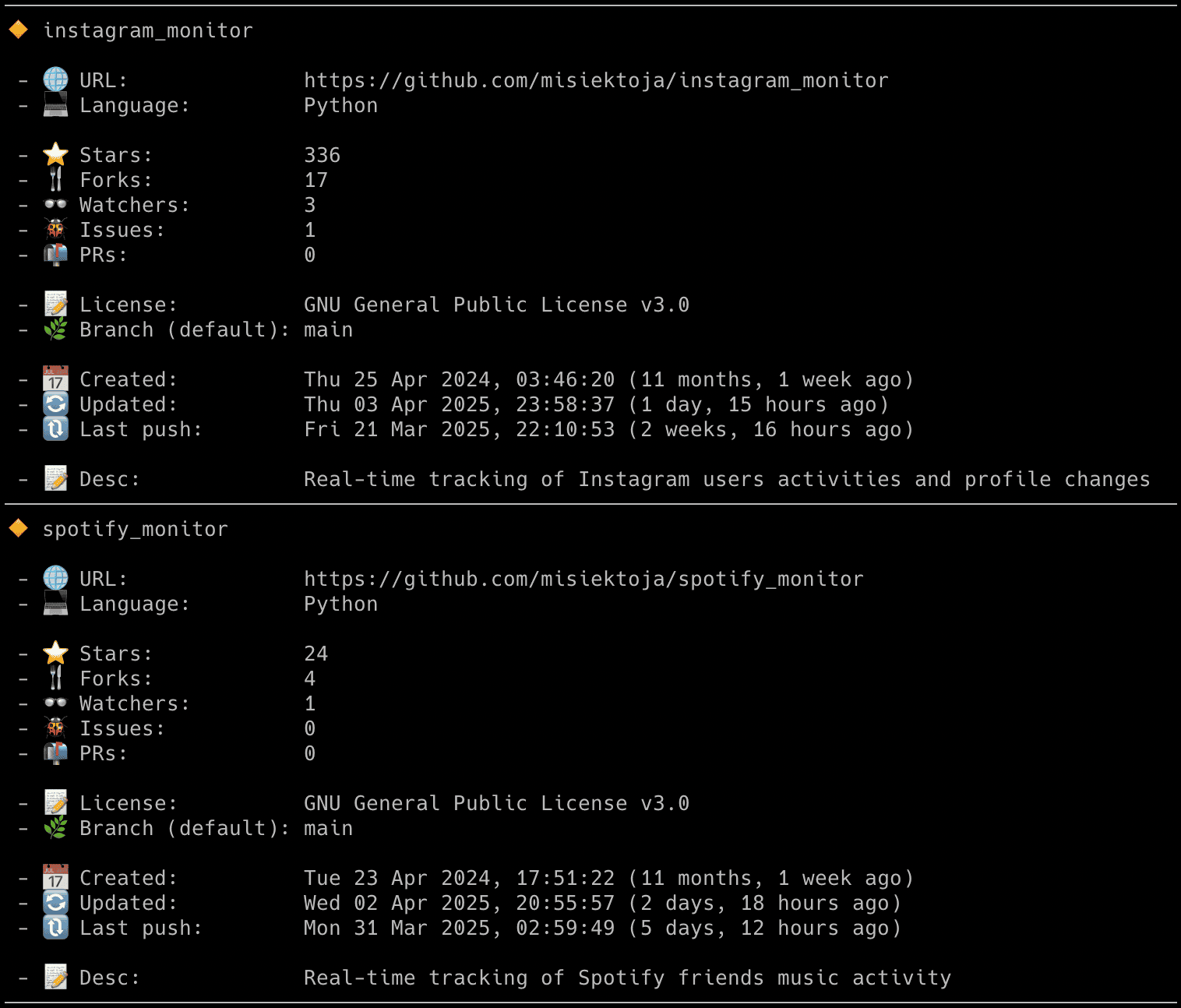
By default, only user-owned repos are listed. To include forks and collaborations, set GET_ALL_REPOS to True or use the -a flag:
If you want to display a list of repositories starred by the user then use the -g flag:
If you want to display a list of followers and followings for the user then use the -f flag:
If you want to get the list of recent GitHub events for the user then use the -l flag. You can also add the -n flag to specify how many events should be displayed. By default, it shows the last 5 events.
If you want to not only display, but also save the list of recent GitHub events to a CSV file, use the -l flag with -b indicating the CSV file. As before, you can add the -n flag to specify how many events should be displayed/saved:
Email Notifications
To enable email notifications for all user profile changes (e.g. changes in followers, followings, starred repositories, username, email, bio, location, blog URL and number of repositories):
- set
PROFILE_NOTIFICATIONtoTrue - or use the
-pflag
To receive email notifications when new GitHub events appear for the user (e.g. new pushes, PRs, issues, forks, releases etc.):
- set
EVENT_NOTIFICATIONtoTrue - or use the
-sflag
To get email notifications when changes in user repositories are detected (e.g. changes in stargazers, watchers, forks, issues, PRs, discussions, descriptions, etc., except for the update date):
- set
REPO_NOTIFICATIONtoTrue - or use the
-qflag
To be informed whenever changes in the update date of user repositories are detected:
- set
REPO_UPDATE_DATE_NOTIFICATIONtoTrue - or use the
-uflag
The last two options (-q and -u) only work if tracking of repositories changes is enabled (-j).
To be informed about a user's daily contributions:
- set
CONTRIB_NOTIFICATIONtoTrue - or use the
-yflag
The -y flag only works if tracking of daily contributions is enabled (-m).
To disable sending an email on errors and the recovery alert that follows (both enabled by default):
- set
ERROR_NOTIFICATIONtoFalse - or use the
-e/--no-error-notifyflag
Email and webhook error alerts are sent after 5 minutes of a continuing failure. Problems that need your action, such as a rejected token, alert immediately. Each kind of failure alerts once per channel. Failed deliveries are retried after 5 minutes, with increasing waits up to an hour. A new outage after a recovery alerts again. A channel that could not receive the failure alert while the outage lasted is told about the failure and its recovery together, so a blocked channel is not left without any word of an outage.
A failure alert carries the subject GitHub Monitor error: <what went wrong> (user: <username>) and lists the fix, the guide link, how many checks failed in a row, since when and when the next retry is. When the failure clears, a matching GitHub Monitor recovered: ... alert goes to the channels the failure alert reached. -e / --no-error-notify switches both off for email and --no-webhook-error-notify switches both off for webhooks.
Missing optional details, such as a push event's file list, are reported on screen without triggering an error alert. When several checks fail, the alert shows the action to take and the number of other failures.
You can combine all email notifications flags together if needed.
Make sure you defined your SMTP settings first, as described in SMTP Settings.
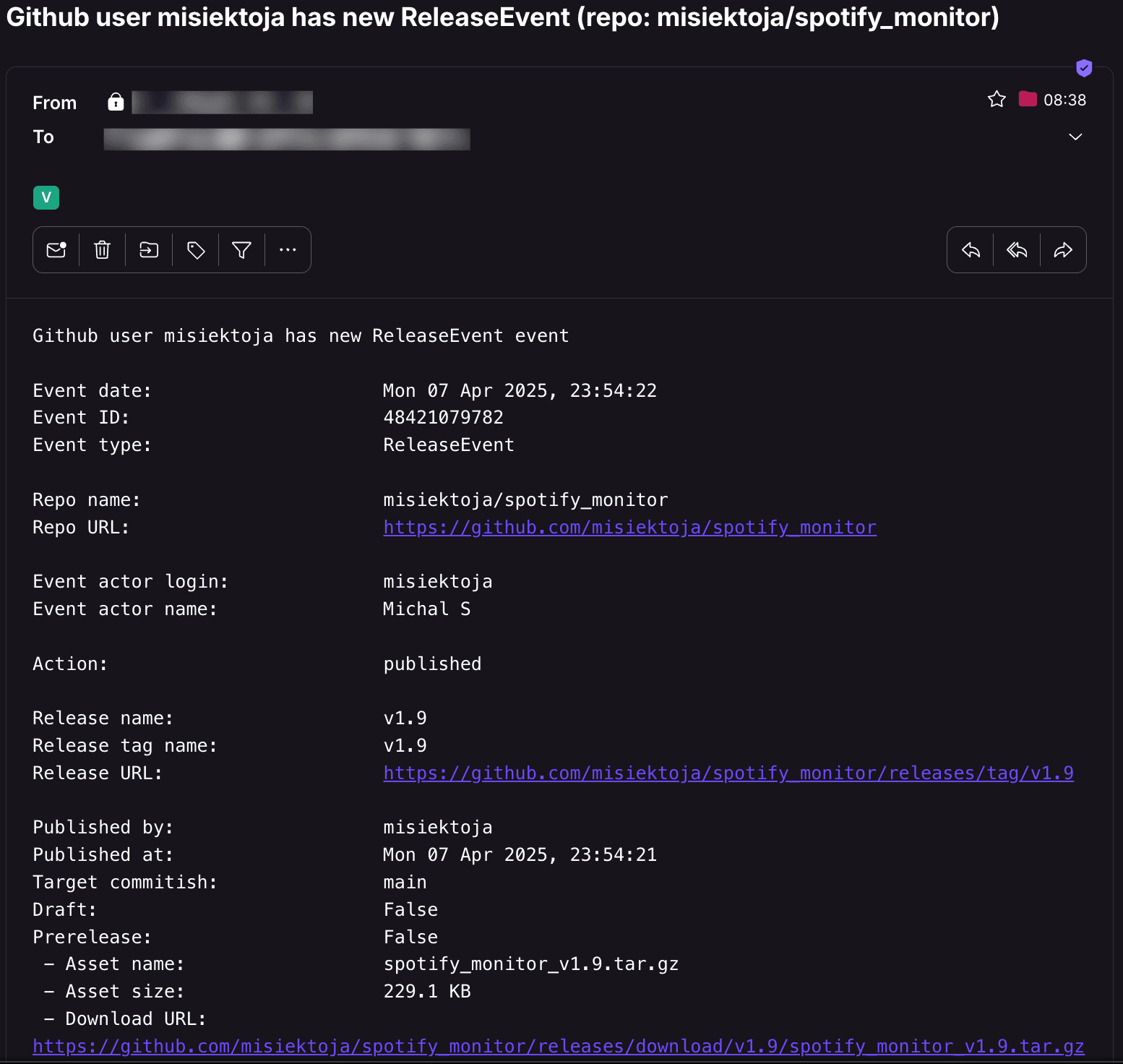
Example email:
Webhook Notifications
Webhook event controls mirror the email categories but work independently:
| Event | Config setting | CLI override |
|---|---|---|
| Profile changes | WEBHOOK_PROFILE_NOTIFICATION |
--webhook-profile |
| New GitHub events | WEBHOOK_EVENT_NOTIFICATION |
--webhook-events |
| Repository changes | WEBHOOK_REPO_NOTIFICATION |
--webhook-repo-changes |
| Repository update date changes | WEBHOOK_REPO_UPDATE_DATE_NOTIFICATION |
--webhook-repo-update-date |
| Daily contribution changes | WEBHOOK_CONTRIB_NOTIFICATION |
--webhook-daily-contribs |
| Monitoring errors and recoveries | WEBHOOK_ERROR_NOTIFICATION |
Enable with --webhook-errors or disable with --no-webhook-error-notify |
A monitoring error webhook carries the same title and fields as the error email, without the timestamp the webhook service shows itself, and the matching recovery alert follows on the same channel. --no-webhook-error-notify switches both off.
Use --webhook or --no-webhook to turn all configured webhook alerts on or off for one run. A category override also enables the master webhook switch. For example:
Repository webhook categories only work with -j or --track-repos-changes. Contribution webhooks only work with -m or --track-contribs-changes. Event webhooks are disabled when -k or --no-monitor-events is used.
The provider and destination can also be overridden for one run:
github_monitor github_username --webhook-provider ntfy --webhook-url "https://ntfy.sh/your-private-topic" --webhook-events
See Webhook Settings for private URL setup, ntfy authentication and advanced payload customization.
CSV Export
If you want to save all GitHub user events, profile changes and repository updates to a CSV file, set CSV_FILE or use the -b flag:
The file will be automatically created if it does not exist.
Check Intervals
If you want to customize the polling interval, use the -c flag (or the GITHUB_CHECK_INTERVAL configuration option):
It is generally not recommended to use values lower than 10 minutes as new events are very often delayed by the GitHub API.
NET_MAX_RETRIES defaults to 5 and counts the first request as an attempt. NET_BASE_BACKOFF_SEC sets the base retry delay and defaults to 5 seconds. GitHub rate-limit headers can specify a different wait. If a monitored feed remains unavailable after its attempts, its previous snapshot is kept and monitoring tries again on the next check.
VERIFY_REPOSITORY_CLOSURES defaults to True. Missing issues, pull requests and discussions require confirmation of their closed state, with a separate fixed limit of five extra HTTP requests per monitoring cycle across all repositories. These lookups do not use NET_MAX_RETRIES or follow redirects. Unverified items stay in the previous snapshot and are checked again on later cycles. Set VERIFY_REPOSITORY_CLOSURES = False to restore immediate disappearance-based alerts without verification requests. The verbose/debug startup summary shows the setting and shared budget. The budget shows Inactive when repository tracking or verification is disabled. See Monitoring Mode.
An interval below 30 seconds invites the GitHub rate limiter, which stops the tool seeing anything. --doctor warns when the configured interval is that short.
Liveness Reminder
While nothing changes, the tool prints one reminder that it is still running:
* Monitoring healthy for <github_target>. No tracked change since the last check
Liveness check, timestamp:  Mon 08 Sep 2026, 09:15:05
Set LIVENESS_CHECK_INTERVAL to change it (default: 86400, i.e. 24 hours) or to 0 to switch it off.
Anything the tool prints about the target restarts the countdown, so a busy run stays quiet.
Signal Controls (macOS/Linux/Unix)
The tool has several signal handlers implemented which allow to change behavior of the tool without a need to restart it with new configuration options / flags.
List of supported signals:
| Signal | Description |
|---|---|
| USR1 | Toggle email notifications for all user's profile changes (-p) |
| USR2 | Toggle email notifications for new GitHub events (-s) |
| CONT | Toggle email notifications for user's repositories changes (except for update date) (-q) |
| PIPE | Toggle email notifications for user's repositories update date changes (-u) |
| URG | Toggle email notifications for user's daily contributions changes (-y) |
| TRAP | Increase the user check interval (by 1 min) |
| ABRT | Decrease the user check interval (by 1 min) |
| HUP | Reload secrets from .env file |
SIGHUP keeps command-line credentials and nonempty environment values exported before startup. Change those values and restart to replace them.
Send signals with kill or pkill, e.g.:
As Windows supports limited number of signals, this functionality is available only on Linux/Unix/macOS.
Coloring Log Output with GRC
You can use GRC to color logs.
The bundled recipe follows the same colors as the live output. It also covers the other monitors in the family, so one copy in ~/.grc/ colors every tool's logs.
Add to your GRC config (~/.grc/grc.conf):
Now copy the conf.monitor_logs to your ~/.grc/ and log files should be nicely colored when using the grc tool.
Example: